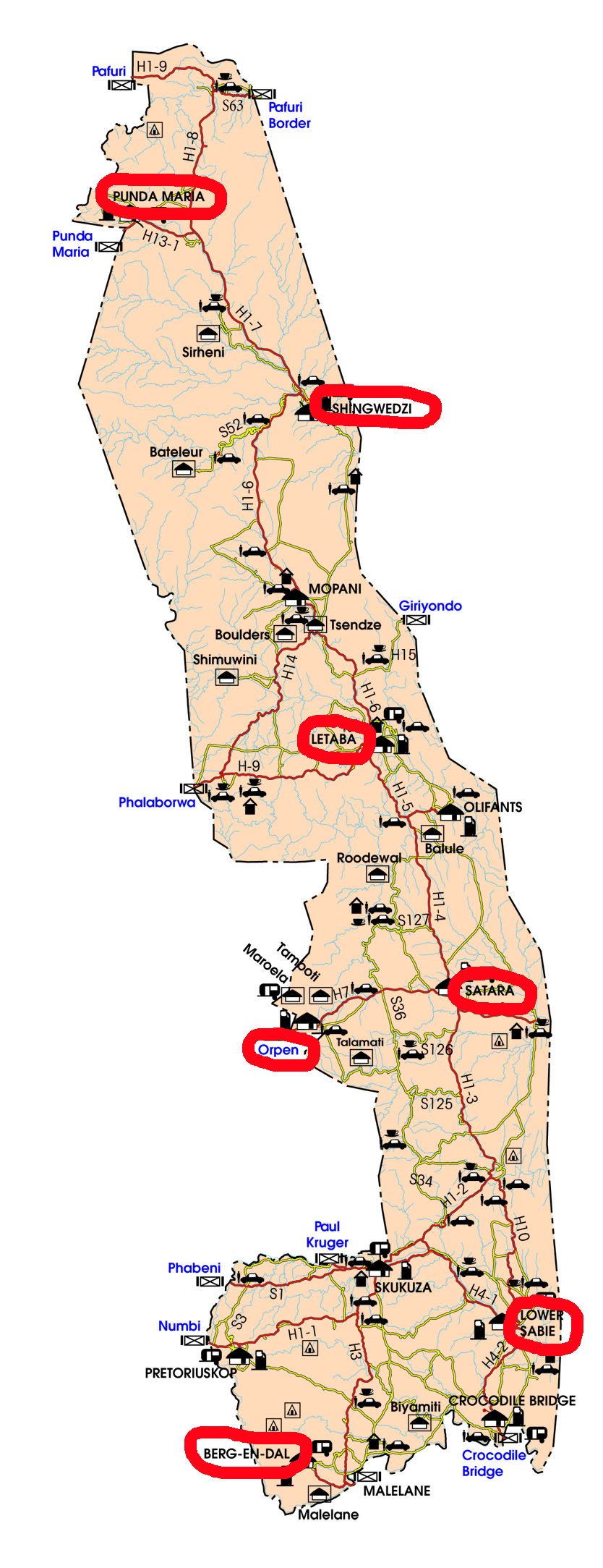
 Kaye had previously spent a week in Kruger with her sister and their South African friend Judy, but Geoff had only visited the National Park on a day trip many years ago. This time we were to spend eleven nights in the park, driving from the northernmost gate (Pafuri) to the most southerly (Crocodile Bridge).
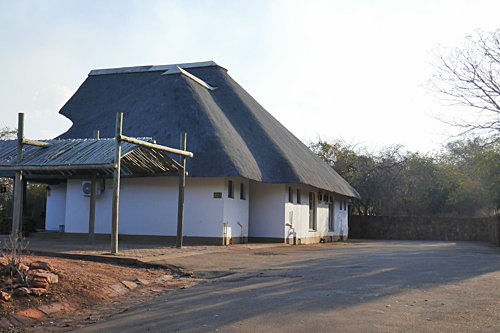 This is the drier northern area, and we had expected it to be mainly a birding experience. Not true. We saw lots of elephants, giraffe, and various antelope, as well as lots of birds. We stayed in rather a large three-bedroom chalet, with baboons running around outside. This is where we found out that our age really mattered - we were unable to take a walking tour because we are all over sixty and hadn't known that we would need a doctor's certificate if we wanted to have a guided walk anywhere in the park. When we were driving around we were horrified to see a dead elephant not far off the road. There were no predators or scavengers around - just the elephant, laying still, with its tusks pointing towards the sky. We reported it, then looked for it as we drove back that way later in the day, but we couldn't see it again. It turned out that our 'dead' elephant was in a deep sleep - apparently it subsequently woke up, turned its head around the correct way, got up and lumbered on its way!
The picture is of our accommodation at the camp.
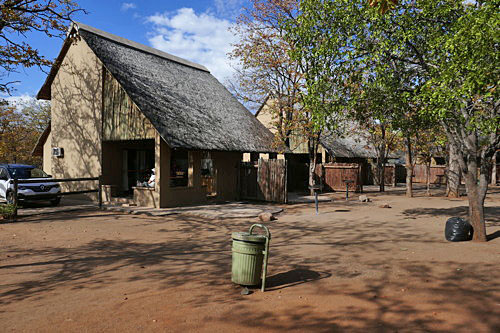 This area of more open grasslands is known for its elephants and its large herds of buffalo. There were also lots of buck, and hippos in the rivers. This was also the area where we saw our first lion. We were driving along slowly when two warthogs raced across the road in front of car, followed by a lioness, which stopped on the road, walked briefly towards us, then retraced her steps back into the riverbed. We had two cabins at the camp, giving us all a bit more room and privacy.
The picture is of our accommodation at the camp.
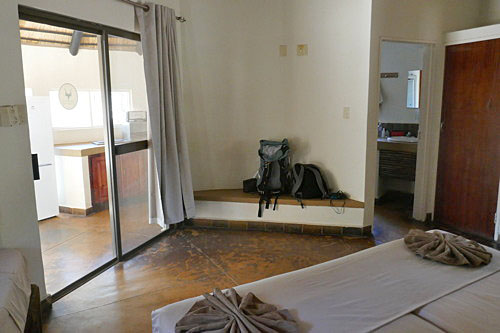 Letaba is in an area of grassland surrounded by mopani veld, and the camp is located on the Letaba river. Lots of elephants, some very boisterous hippos, and a wide range of other animals were there, including another chance sighting of a lion, which strolled out onto a riverbed just as we were driving across it. We stopped for lunch at Masorini Heritage Site, giving us a chance to walk around the reconstructed village. We also booked ourselves onto a night drive - we saw a couple of hyenas and a few other animals, but the guide wasn't very good at communicating with those of us on the tour so we often didn't know where to look. The general problem with night drives is that they are in darkness, so the only things which can be seen are those which are found in a spotlight.
The picture is inside our accommodation at the camp.
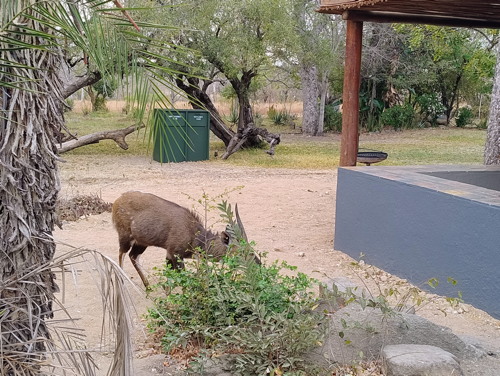 Orpen is a small camp very close to the Orpen Gate leading back out of the camp on the far western border. There were bush buck wandering around, keeping the bushes trimmed. This is an area to see zebra, wildebeest, giraffe, impala and elephants. We also managed to see ground hornbills, one of our favourite large birds with black bodies and bright red areas around the head.
The picture is of a bush buck alongside our bungalow.
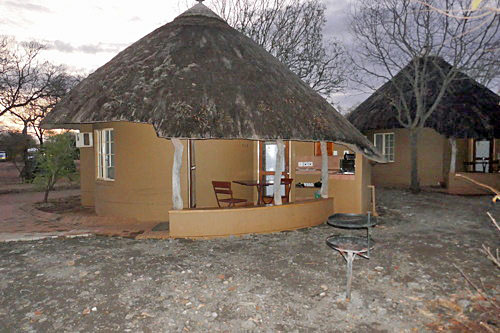 The bush around Satara is relatively open, and it is said to be a good place to see big cats. The identical camp buildings are set out in a series of circles, causing us to drive around and around at times trying to find our accommodation! We had a wonderful viewing of a family of hyenas out from Satara. It had just rained, and the entire family were out on the sealed road licking the fresh water from the surface. They had a den in a culvert under the road, and there were animals of all ages. A lot of cars had stopped on the road with everyone watching, but the hyenas took little notice of all of us staring humans - they walked in and out of the traffic, sat under cars, and licked the water up as it pooled. This area also had several good water holes where a variety of animals came in to drink. We went on a late afternoon organised drive where a pride of lions decided to lie down on the road and stop the traffic completely. Back at the camp there were bush buck wandering around doing their pruning work again.
The picture is of our accommodation at the camp.
 Despite the fact that this camp is on one of the few rivers with permanent water we didn't see as much here as in other areas. There were giraffe and elephants, and birds, of course, but we don't have a great collection of pictures from our stay here.
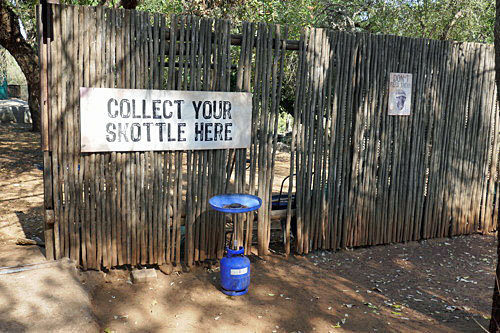
We do not have a picture from Lower Sabie camp, so the picture is of one of the rest stops in the area. These rest stops are unfenced areas where there are a range of facilities, sometimes just chairs, tables and toilets, but in others food outlets and shops selling tourist stuff. A "skottle" is a gas-powered brai (barbeque - the blue device in the picture) which can be hired to cook your lunch.
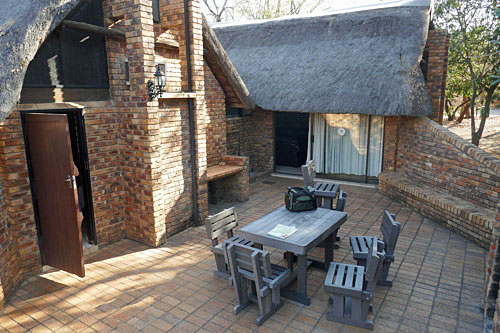 We had been unable to get two nights accommodation in Lower Sabie, so we had booked at Berg-en-Dal for our last couple of days in the park. It turned out to be a good camp to stay in. We had a very good lion sighting - a pride on the move, walking around in amongst the cars. We opted for an early morning organised game drive - it had good bits and not so good bits. Good bits were the family of hyenas with a den right by the road and the elephants with a tiny baby - about two days old. Not so good bit was the cold and the driver's obsession with showing us a leopard with its kill up in a tree. We didn't get to see anything - as soon as we thought we could see it he would move the vehicle, and all would be obscured again. As it happens we went back to that area later in the day in our own car. It was packed out with vehicles, but we managed to get a completely different angle on the tree and could see that there were two leopards (possibly a mother and cub). The larger animal ran off, but the smaller one stayed rather awkwardly perched in the tree.
The picture is of our accommodation at the camp.